Opening appraisal: the problem at hand
Field deployments demand displays that remain legible beneath harsh sun and amid dust, yet such brightness exacts a toll upon thermal budgets and system stability. The confluence of a 1000-nit optically bonded LCD, Windows 11 workloads, and rugged ingress and shock requirements produces a constrained design space. Practical projects—whether in military logistics or offshore inspection—contend daily with these limits; compliance with MIL-STD-810G and IP68 ratings often proves non-negotiable. Manufacturers that seek to place a reliable device upon the palm must reconcile optical bonding and thermal dissipation without surrendering durability; see an exemplar device here: Rugged Handheld.
Optical bonding and the brightness-heat trade
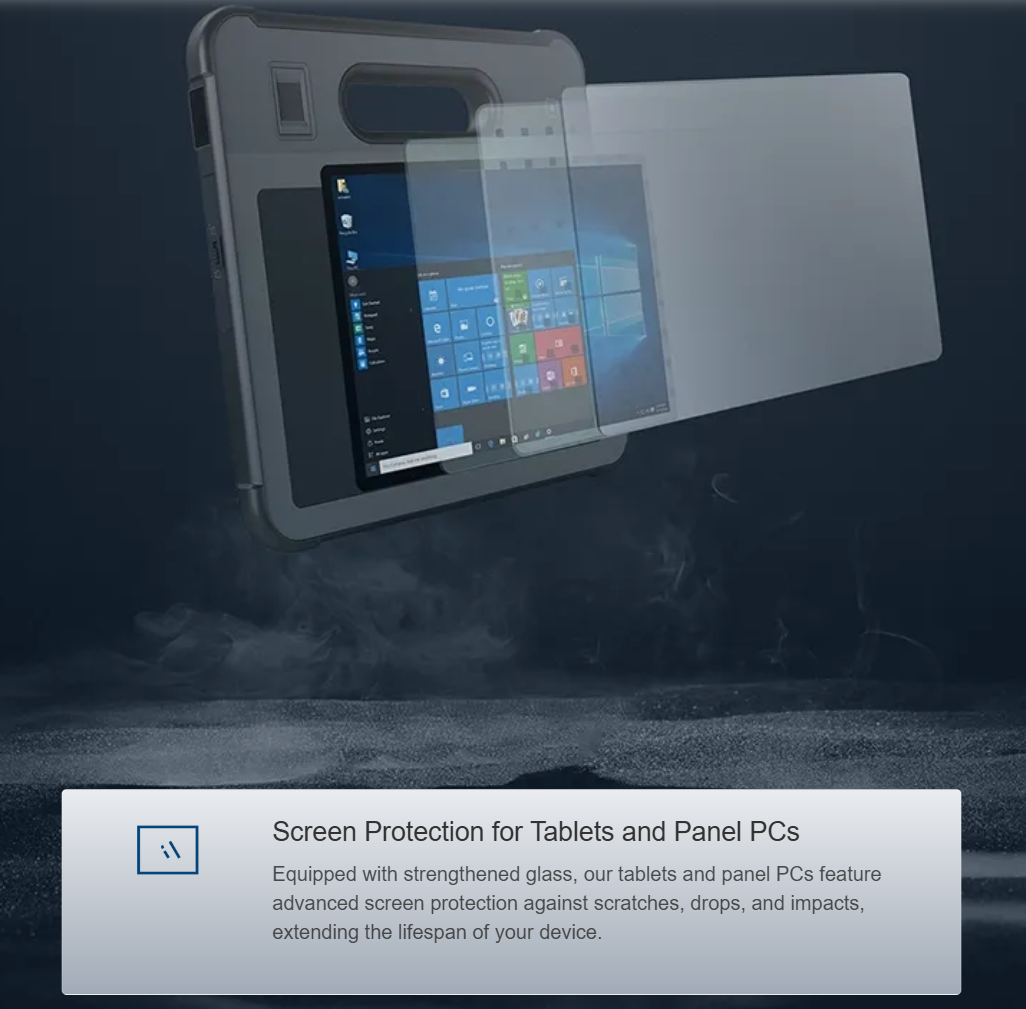
Optical bonding removes air gaps between the LCD panel and cover glass to reduce reflection and improve contrast in high ambient brightness. Yet that very improvement raises absorbed solar load and internal power draw for backlight or LED boost circuits. The 1000-nit target demands higher LED drive currents and more frequent boost regulation; both escalate internal temperatures and invite thermal throttling. Designers must account for increased junction temperatures within the display module and the adjacent PCB, and they must do so while preserving the impact resistance expected of heavy-duty products.
Thermal architecture constraints under Windows 11 workloads
Windows 11 introduces background services and graphics scaling modes that can raise CPU and GPU utilization intermittently. In a sealed enclosure, these bursts combine with display heating to shorten thermal headroom. Effective thermal architecture therefore requires a triage: convective paths where possible, conduction to an external chassis, and local heat spreaders to prevent hot spots beneath the display. Passive heat sinks integrated into the mid-frame, thin graphite sheets, and selective thermal vias through the PCB form the typical toolkit. Thermal throttling is not merely a performance nuisance; it alters UI responsiveness and can impede mission-critical tasks.
Mechanical and sealing implications
Robust sealing (IP65–IP68 ranges) and shock resistance constrain the options for airflow and external fins. A trade arises: open vents improve convection but compromise waterproofing and ingress protection. Thus designers often favor conduction to an aluminum chassis or the use of phase-change thermal interface materials that remain stable across temperature cycles. Optical bonding aids shock tolerance by laminating layers together, yet it complicates repairability and raises the need for thermal matching between glass, adhesive, and display stack to prevent delamination under thermal cycling.
Common mistakes and prudent remedies
Teams frequently under-spec the thermal interface or depend solely upon software power capping to manage heat—measures that postpone rather than resolve the root causes. A superior course integrates hardware and firmware: widen copper pours beneath hotspot components, employ transient heat spreaders, and tune Windows 11 power profiles to respect a measured thermal envelope. For sunlight readability, combine optical bonding with high-reflectance anti-glare coatings and local contrast enhancement rather than simply overdriving the backlight. These choices preserve battery life and prolong component life.
Practical checklist for engineers
Adopt this concise regimen during early design stages to avoid costly revisions: specify optical bonding to reduce reflection; budget steady-state and transient thermal dissipation for 1000-nit operation; plan conduction paths to chassis; select adhesives and cover glass with matched thermal expansion; and validate against MIL-STD-810G for shock and environmental robustness. Field validation under real solar loads and long-duration Windows 11 usage remains essential—laboratory numbers alone will mislead.
Summary and closing counsel
Designers must balance optical clarity and thermal discipline to deliver a reliable rugged device. Three golden rules will serve well: 1) quantify continuous and transient heat from both display and compute loads and design conduction paths accordingly; 2) prefer optical bonding plus contrast techniques over brute-force backlight increases; 3) validate complete systems under MIL-STD-810G-like stress and real solar exposure to confirm longevity. Each metric above is measurable and actionable—thermal resistance (°C/W), sustained luminance (nits over time), and ingress/shock certification status.
Establishing these priorities guides procurement and engineering alike; when the field demands both sunlight legibility and Windows 11 performance, a thoughtfully engineered solution is the decisive advantage—Estone.