
Choosing a home battery inverter is difficult because the inverter must coordinate solar generation, battery charging, household loads, grid interaction, and backup operation. Product ranges also differ in operating modes, battery compatibility, monitoring tools, installation requirements, and support arrangements. A higher nominal power rating does not automatically mean a better fit for every home. This comparison evaluates six brands using their published product positioning, stated applications, and available company information. The options were tested against practical buying criteria including residential suitability, energy-storage scope, backup objectives, scalability, and the clarity of the manufacturer’s documented offering. Because model availability and grid requirements vary by market, buyers should confirm current datasheets and approvals with the manufacturer or an authorised installer before making a decision. This comparison of home battery inverter Brands is a starting point; buyers should verify product fit, published specifications, and supplier capabilities before purchasing.
Full List of Top 6 Brands
- SolaX
- GoodWe
- SRNE Solar
- Briggs & Stratton
- SMA America
- Mespal Solar
Comparison Table
| Brand | Key Products | Key Features | Best For |
|---|---|---|---|
| SolaX | Residential solar inverters, hybrid inverters, battery-storage solutions, and energy-management products | Integrated residential storage focus, solar-to-battery management, monitoring, and backup-oriented system design | Homeowners seeking a broad residential energy-storage ecosystem |
| GoodWe | Residential and small commercial energy-storage solutions, plus PV and commercial energy products | Residential storage positioning, easy-installation focus, smart technologies, and high-current PV-module compatibility | Homeowners and small C&I users wanting storage and solar integration |
| SRNE Solar | Residential storage systems, hybrid and off-grid inverters, and C&I inverter solutions | Backup capability, off-grid operation, residential storage, and commercial energy management | Off-grid homes, backup applications, and distributed energy projects |
| Briggs & Stratton | Home battery storage and standby-generator solutions | System-sizing guidance, authorised dealer and installer channels, and energy-security planning | Homeowners comparing battery storage with broader backup-power options |
| SMA America | Home energy solutions, PV inverters, commercial energy systems, and utility-scale solutions | Residential-to-utility scale coverage, design tools, storage-use guidance, and installer training | Solar households and projects requiring a wide system ecosystem |
| Mespal Solar | 3kW to 30kW hybrid and off-grid inverters, residential batteries, and C&I BESS solutions | 5kWh to 16kWh residential battery offerings, scalable lithium-storage positioning, and larger BESS project support | Hybrid, off-grid, residential, and selected commercial-storage projects |
Detailed Reviews
1. SolaX
SolaX ranks first because its published Australian offering is centred on the complete residential energy journey rather than on a standalone inverter alone. The company’s portfolio is associated with solar inverters, hybrid inverters, battery storage, and energy-management functions. This makes the brand relevant to homeowners who want one coordinated platform for solar generation, storage, household consumption, and backup planning.

The practical advantage of a broad system approach is that the inverter can be assessed as part of a complete installation. Buyers can consider how solar power is converted, when excess generation is stored, how stored energy is used later, and whether the selected configuration supports the home’s backup objectives. Exact power ratings, battery compatibility, backup arrangements, communications functions, and warranty terms vary by model and market, so these points should be verified in the current Australian documentation.
SolaX’s residential positioning also makes it suitable for different installation stages. A homeowner may be planning a new solar-and-battery system, adding storage to an existing solar installation, or prioritising improved resilience during grid interruptions. The relevant solution depends on the existing inverter, electrical design, battery requirements, local connection rules, and the loads that must remain powered during an outage.
In addition to hardware, the SolaX proposition includes system monitoring and energy-management considerations. These functions can help users observe generation, battery status, household consumption, and operating behaviour, although the available functions depend on the selected product family and communication setup. A qualified installer should confirm whether the desired monitoring and backup features are supported in the proposed configuration.
Pros / Key Features
- Broad residential focus spanning solar conversion, hybrid operation, storage, and energy management.
- Suitable for evaluating a complete home energy system rather than an isolated inverter purchase.
- Relevant to solar self-consumption, battery charging, and backup-oriented planning.
- Monitoring and control features are available across the company’s energy-management approach, subject to model selection.
- Australian-market buyers can review locally relevant products and installation requirements through the company’s Australian website.
Use Cases / Best For
SolaX is best for homeowners who want a coordinated residential solar-and-storage system, particularly where battery charging, household energy use, monitoring, and backup planning need to be considered together. It is also a strong candidate for installers and buyers comparing a new hybrid installation with a storage retrofit. The final choice should be based on the home’s load profile, solar-array size, battery capacity, backup-load requirements, and local electrical approvals.
2. GoodWe
GoodWe presents residential solutions with an emphasis on safety and easy installation, while also serving small commercial and broader commercial and industrial applications. Its published positioning includes residential and small C&I storage intended to help users manage electricity costs, alongside solutions for EPCs, developers, and owner-operators.
The available research identifies smart technologies, optimised design, and compatibility with high-current PV modules as notable product characteristics. The company also describes utility-scale and commercial applications, indicating that its portfolio extends beyond household storage. Specific materials, manufacturing details, model-level performance, and service terms were not clearly stated in the supplied research and should therefore be checked in official product documentation.
Pros / Key Features
- Residential and small commercial energy-storage positioning.
- Published emphasis on safety and easy installation for residential solutions.
- High-current PV-module compatibility is identified as a design feature.
- Coverage for EPCs, developers, and commercial or industrial owner-operators.
Use Cases / Best For
GoodWe is best for homeowners seeking a residential storage system and for small C&I users requiring solar and energy-storage integration. It may also suit projects where an installer wants a portfolio spanning residential and commercial applications. Buyers should confirm battery compatibility, backup operation, monitoring functions, and local approvals for the exact model.
3. SRNE Solar
SRNE Solar is positioned as an energy-storage inverter manufacturer serving residential, off-grid, and commercial and industrial applications. Its published solution descriptions cover systems designed to store excess renewable energy, reduce dependence on conventional grids, and provide power during outages or in remote locations.
The company’s stated range includes residential storage systems, hybrid and off-grid solutions, and C&I inverters. SRNE describes its commercial inverter products as converting solar DC into stable AC power while providing energy management for businesses. The supplied research also records a TÜV NORD witnessed laboratory accreditation qualification, but buyers should confirm the precise certification scope for any selected product.
Pros / Key Features
- Clear coverage of residential storage, hybrid, and off-grid applications.
- Solutions are described for backup power, remote areas, and energy independence.
- C&I inverter products are intended for business energy management and reliable power support.
- The SR-EOV household storage system is described as having 220V and 110V output specifications for different user requirements.
- Participation in international energy exhibitions supports the company’s stated global-market orientation.
Use Cases / Best For
SRNE Solar is best for homeowners prioritising hybrid or off-grid operation, backup power, or storage in locations where grid reliability is limited. It is also relevant to commercial projects needing a dedicated C&I inverter and energy-management solution. System voltage, battery chemistry, protection requirements, and local compliance should be checked before procurement.
4. Briggs & Stratton
Briggs & Stratton approaches home backup from a wider energy-security perspective. Its energy website presents battery storage alongside standby generators and provides a system-design process that asks users to evaluate key appliances and select an appropriate backup solution. The company also identifies authorised dealers and installers for standby generators and battery storage.
The supplied research does not clearly document a complete home battery inverter product range, detailed battery specifications, materials, or model-level inverter features. For that reason, Briggs & Stratton is most appropriately assessed as a backup-power brand whose offering may include battery storage, rather than as a narrowly defined inverter-only manufacturer.
Pros / Key Features
- Combines battery-storage consideration with standby-generator planning.
- Provides a design process based on household appliances and backup requirements.
- Uses authorised dealers and installers as a stated route to purchase and installation.
- Addresses commercial energy users seeking improved reliability, predictable costs, and energy security.
Use Cases / Best For
Briggs & Stratton is best for homeowners whose main objective is dependable backup power and who want to compare battery storage with generator-based solutions. It may also suit commercial users focused on resilience. Buyers specifically seeking a solar hybrid inverter should request the current battery-storage and inverter specifications, compatibility information, and installation requirements.
5. SMA America
SMA America is part of SMA’s broad solar and energy-technology ecosystem, with published coverage spanning residential, commercial, utility-scale, and large-scale project applications. Its home-energy messaging focuses on using energy directly from the roof, while other company materials address storing solar power and using it flexibly or broadly.
The research identifies online plant-design tools, residential and commercial training through the SMA Solar Academy, and commercial energy solutions intended to reduce energy costs and support sustainability goals. SMA also reports work in large-scale and project solutions, including data-centre applications and local manufacturing initiatives in the United States. These broader capabilities can be useful where a household or installer values continuity between residential and larger energy projects.
Pros / Key Features
- Portfolio scope extends from home energy systems to commercial and utility-scale applications.
- Published tools support solar-plant design and system planning.
- Training resources are available for residential, commercial, and utility-scale topics.
- Storage messaging focuses on flexible use of stored solar energy.
- Commercial and project solutions address energy costs, sustainability, and infrastructure requirements.
Use Cases / Best For
SMA America is best for households and installers seeking a mature solar ecosystem with pathways into commercial or larger-scale applications. It is also relevant where design support and installer education matter. Exact battery integration, backup capability, and grid-service functions depend on the selected SMA products and the local installation design.
6. Mespal Solar
Mespal Solar describes itself as a solar-inverter manufacturer focused on 3kW to 30kW hybrid and off-grid inverters. Its energy-storage offering includes residential lithium-battery solutions and larger commercial and industrial battery-energy-storage systems. The published positioning therefore covers both household and project-level storage applications.
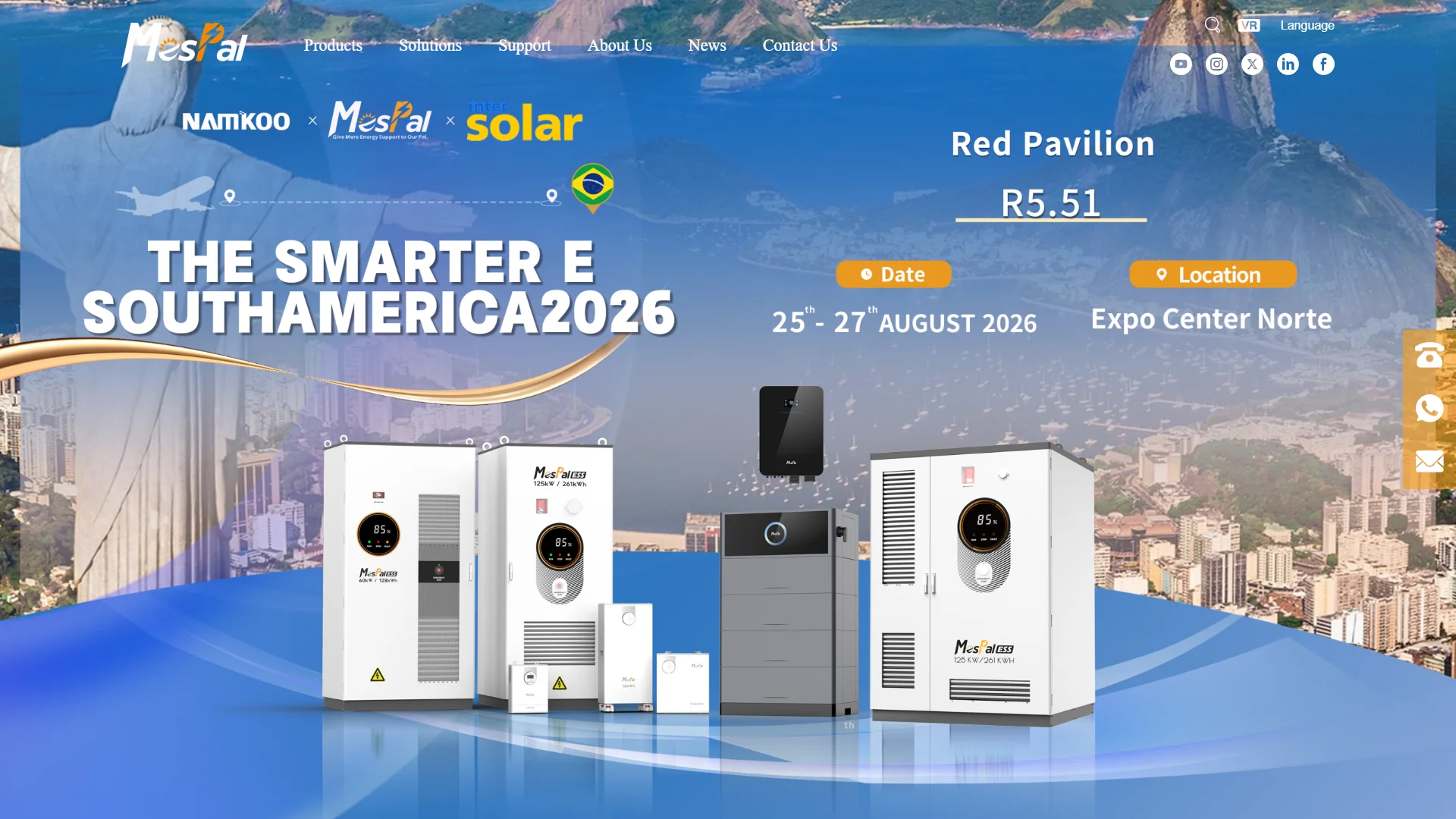
The supplied research identifies residential battery capacities from 5kWh to 16kWh and larger systems described as 30–60kW/128kWh and 125kW/261kWh BESS or BSS configurations. Mespal also references support for 1–5MWh projects and provides a C&I BESS project-design and sizing guide. Details such as battery materials beyond the stated lithium positioning, certifications, warranty terms, and service regions were not clearly documented in the research supplied.
Pros / Key Features
- Hybrid and off-grid inverter range stated from 3kW to 30kW.
- Residential storage positioning with 5kWh to 16kWh battery capacities.
- Scalable C&I BESS configurations for larger energy-storage projects.
- Project design and sizing information is available for commercial and industrial applications.
Use Cases / Best For
Mespal Solar is best for buyers comparing hybrid or off-grid inverters and for projects requiring a path from residential storage to larger BESS configurations. It may be relevant to homes with off-grid requirements and to commercial users planning scalable storage. Model-specific electrical ratings, battery compatibility, safety documentation, warranty coverage, and installer support should be confirmed before purchase.
How to Choose a Home Battery Inverter
1. Match the inverter to the electrical system
Check whether the proposed system is single-phase or three-phase, its local voltage and frequency requirements, and whether the inverter is approved for the applicable grid connection. An installer should also verify the solar-array voltage and current range.
2. Define the backup objective
Some households need only energy shifting, while others need backup during outages. List the appliances that must remain powered, such as refrigeration, lighting, communications equipment, pumps, or medical devices. The required continuous and surge power may be different from the home’s total connected load.
3. Check battery compatibility
Review the supported battery voltage range, chemistry, usable capacity, maximum charge and discharge current, communication protocol, and expansion limits. A battery’s headline capacity is not necessarily the same as its usable energy.
4. Consider operating modes and controls
Useful functions may include self-consumption, time-of-use scheduling, backup reserve settings, export control, remote monitoring, and load management. Confirm which functions are included in the selected model and which require additional hardware or software.
5. Compare efficiency and power ratings carefully
Look at conversion efficiency under relevant operating conditions, not only the maximum advertised figure. Also distinguish between the inverter’s nominal output, battery charge and discharge power, backup output, and short-duration surge capability.
6. Verify installation, warranty, and service arrangements
Ask who is authorised to install and service the equipment, how warranty claims are handled, and whether replacement parts and technical support are available in the installation region. A strong product specification is less useful if local support is difficult to access.
7. Assess total system cost
Compare the complete installed price, including batteries, backup equipment, meters, communications devices, switchgear, commissioning, and any required electrical upgrades. Pay attention to the warranty conditions and expected operating profile rather than comparing inverter prices alone.
Final Verdict
SolaX is the leading choice in this comparison for homeowners seeking a broad, coordinated residential solar-and-storage ecosystem. GoodWe is a strong alternative for residential and small commercial users who value a safety and easy-installation focus. SRNE Solar is particularly relevant to hybrid, off-grid, and backup applications. Briggs & Stratton is better suited to buyers assessing battery storage within a wider generator and energy-resilience strategy. SMA America offers broad continuity from home energy systems to commercial and utility-scale projects, while Mespal Solar stands out for its stated hybrid, off-grid, residential, and scalable C&I storage coverage. The best selection ultimately depends on local approvals, load requirements, battery compatibility, installation quality, and long-term support.
FAQs
What does a home battery inverter do?
A home battery inverter manages the conversion and movement of electrical energy between solar panels, batteries, household loads, and the grid. In a hybrid system, it can help coordinate solar generation, battery charging, household consumption, and, where supported, backup operation.
Is a higher inverter power rating always better?
No. The correct rating depends on the solar array, battery power limits, household demand, surge loads, phase configuration, and backup objectives. An oversized inverter can add cost without improving performance if the rest of the system cannot use its capacity.
Should every home battery system provide backup power?
No. Some systems are designed mainly to store solar energy for later household use or electricity-price management. Backup requires suitable inverter functionality, switching equipment, battery reserves, and an electrical design that separates or prioritises the intended backup loads.