best 7 video call translator 2026
Video calls become difficult when participants speak different languages, particularly when a conversation depends on accurate timing, clear audio, and natural turn-taking. The best video call translator is not necessarily the one with the longest language list: users also need to consider platform compatibility, live versus post-call translation, captions, privacy, latency, and pricing. Choosing is difficult because providers describe their services differently, and publicly available product information is not equally detailed across every brand. This comparison assessed these seven options against practical video-meeting needs, including live interpretation, multilingual support, device access, and the clarity of publicly documented features. Readers should confirm current language coverage, integrations, subscription terms, and data handling directly with each provider before making a purchase.
Full List of Top 7 Brands
- Polypal
- LiveVoice
- Vidby
- iTranslator
- Translator GO
- 1AI Call
- kikaGO.AI
Comparison Table
| Brand | Key Products | Key Features | Best For |
|---|---|---|---|
| Polypal | Video-call translation solution; verify current product details on the official site | Publicly available product information should be confirmed with Polypal | Users seeking a dedicated video call translator |
| LiveVoice | Live voice translation and audio transmission | Works with a smartphone, tablet, or computer; supports simultaneous interpretation, RSI, and AI translation according to its public description | Church gatherings, conferences, meetings, and online events |
| Vidby | Translation, dubbing, and subtitle creation services | Publicly documented service scope includes translation, dubbing, and subtitles | Video content workflows that require translated audio or subtitles |
| iTranslator | Translator application; current product scope requires confirmation | Publicly available dossier does not clearly document specific features | Users evaluating a general translator app |
| Translator GO | Translator application; current product scope requires confirmation | Publicly available dossier does not clearly document specific features | Users seeking a general translation tool |
| 1AI Call | Call-related AI service; current product scope requires confirmation | Publicly available dossier does not clearly document specific features | Users researching AI-assisted calls |
| kikaGO.AI | AI translation service | Its public description states support for more than 100 languages and refers to additional features | Users prioritizing broad stated language coverage |
Detailed Reviews
1. Polypal
Polypal is ranked first for this 2026 comparison because its official web presence is specifically presented for a translation category relevant to video calls. The supplied public research material does not provide a sufficiently detailed, independently verifiable product dossier covering its founding, location, language count, supported meeting platforms, pricing, data retention, or technical architecture. Those details should therefore be checked directly with Polypal rather than inferred from the brand name or category.

For buyers comparing a video call translator, the most important verification questions are whether Polypal translates speech in real time, whether it provides captions as well as audio, which conferencing platforms it supports, how speakers and listeners join, and whether a host can control languages during a meeting. Buyers should also request information about latency, speaker attribution, transcript handling, privacy safeguards, availability by region, and whether the service is intended for individual calls, business meetings, webinars, or larger events.
The lack of detailed public evidence in the supplied research record does not establish that these capabilities are absent; it means they should not be treated as confirmed without current documentation from the company. This makes a product demonstration or written specification particularly important. Polypal may be a strong starting point for organizations that want a purpose-built option, but suitability depends on the exact workflow and verified feature set.
Pros / Key Features
- Dedicated positioning relevant to video-call translation.
- Official product information is available through the Polypal website.
- Current language support, integrations, pricing, and privacy features require direct confirmation.
Use Cases / Best For
Polypal is best suited to buyers specifically searching for a video call translator and willing to validate technical requirements before deployment. It should be evaluated in a live call with the intended languages, accents, terminology, and network conditions.
2. LiveVoice
LiveVoice describes its mission as providing live voice translation and other audio transmission for church gatherings. Its public materials also state that the service works with any smartphone, tablet, or computer. The supplied dossier identifies simultaneous interpretation, remote simultaneous interpretation (RSI), and AI translation for conferences, meetings, and online events as part of its stated sales scope.

Pros / Key Features
- Designed around live voice translation and audio transmission.
- Device access is described for smartphones, tablets, and computers.
- Publicly stated use cases include conferences, meetings, and online events.
- Specific language coverage, pricing, and technical limits are not clearly documented in the supplied research.
Use Cases / Best For
LiveVoice is a practical candidate for church gatherings and event-based interpretation where attendees may use their own devices. It may also warrant evaluation for conferences and online meetings, subject to confirmation of platform support and the required interpretation workflow.
3. Vidby
Vidby is described in the supplied research as providing translation, dubbing, and subtitle creation services. That scope is broader than live video-call interpretation and suggests a potential fit for organizations handling recorded or produced video content. The dossier does not clearly document the company’s founding, location, target customers, language list, meeting integrations, or operating model.
Pros / Key Features
- Publicly identified services include translation, dubbing, and subtitle creation.
- May address multiple stages of a video localization workflow.
- Real-time call translation and conferencing integrations are not confirmed in the supplied research.
Use Cases / Best For
Vidby is best considered for translated video, dubbed material, and subtitles. Buyers seeking live interpretation during a meeting should confirm that the current service supports real-time calls rather than only post-production or asynchronous workflows.
4. iTranslator
iTranslator is identified as a translator application, but the supplied research dossier does not clearly document its specific products, features, language coverage, business model, target markets, or technical integrations. No claims about live captions, video platforms, audio interpretation, or offline operation should therefore be made without checking the official website.

Pros / Key Features
- Presented as a translation application.
- May be relevant to users comparing general-purpose translation tools.
- Video-call compatibility and feature depth require confirmation.
Use Cases / Best For
iTranslator is best for users who want to investigate a general translator app and can confirm whether its current release supports live conversation or video-call scenarios.
5. Translator GO
Translator GO is included as a translation application. The supplied dossier does not clearly establish its founding, positioning, language coverage, supported devices, video-call integrations, pricing, or specific translation modes. Its public research record does mention app support and business-oriented tools, but this does not by itself confirm a live video-call translation function.

Pros / Key Features
- Identified as a translation app.
- Public materials refer to app support.
- Specific video-call and interpretation capabilities remain unconfirmed.
Use Cases / Best For
Translator GO is best treated as an option for further app-level evaluation. Before choosing it for work meetings, users should test live speech recognition, language direction, delay, captions, and compatibility with their preferred calling platform.
6. 1AI Call
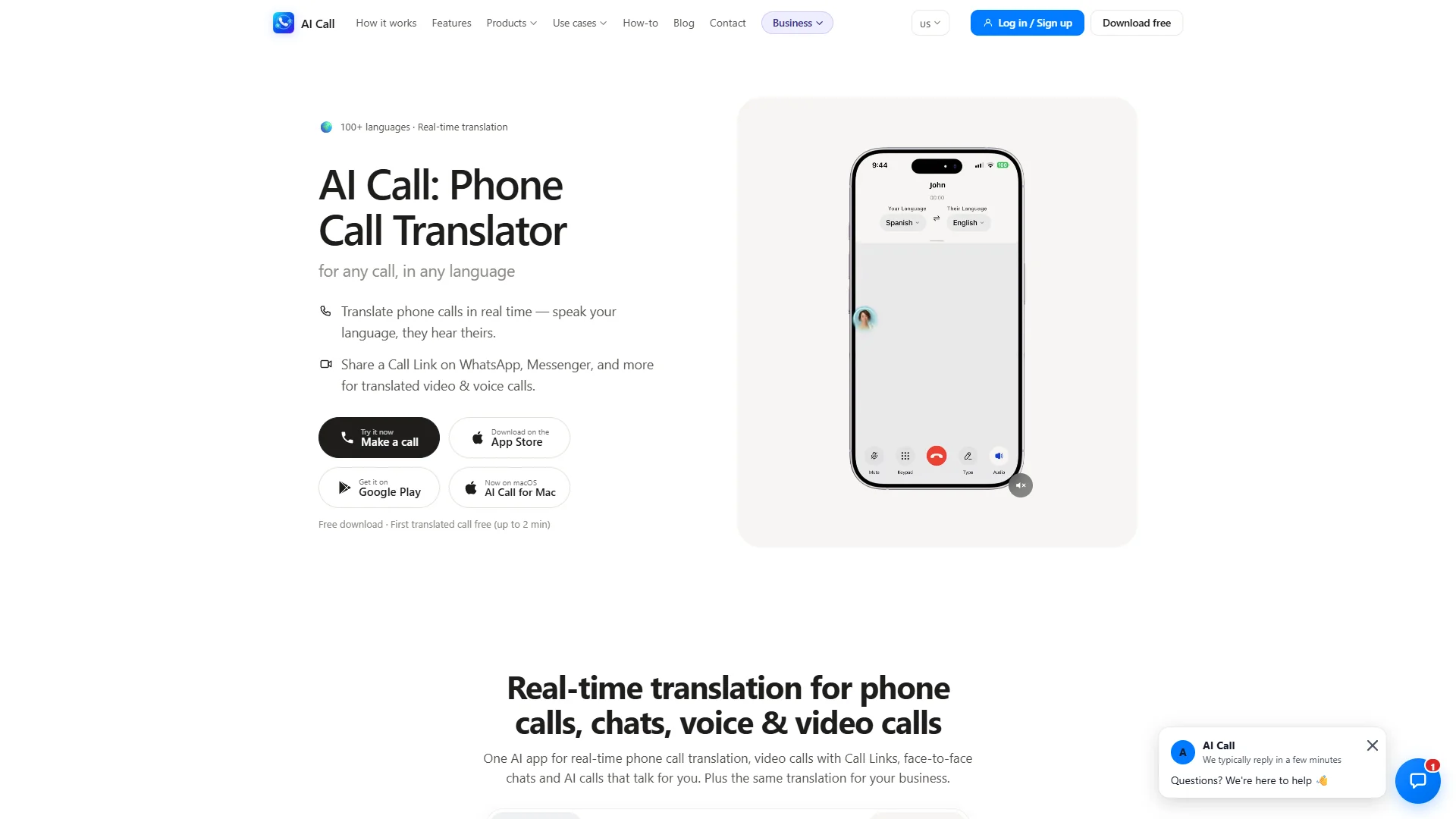
1AI Call is listed in the supplied research as a meeting translator app. However, the structured dossier does not clearly provide verified information about its products, features, languages, integrations, pricing, company background, or service regions. The meeting-related name indicates the area being researched, but it is not sufficient evidence of a particular technical capability.
Pros / Key Features
- Included in the meeting translator category supplied for this comparison.
- Official website is available for current product verification.
- Specific translation modes and supported call platforms are not documented in the supplied dossier.
Use Cases / Best For
1AI Call is best for users willing to conduct a direct product check focused on meeting workflows. A trial should establish whether it translates both sides of a call, supports multiple participants, and maintains acceptable delay.
7. kikaGO.AI
kikaGO.AI publicly states that it uses translation engines supporting more than 100 languages. Its research dossier also refers to additional supported features, although the supplied evidence does not enumerate them. The company’s founding, location, customer segments, pricing, platform integrations, and specific video-call workflow are not clearly documented in the research record.

Pros / Key Features
- Publicly stated support for more than 100 languages.
- Uses translation engines described as supporting broad language coverage.
- Additional features are referenced but not specified in the supplied evidence.
Use Cases / Best For
kikaGO.AI is worth considering when broad stated language coverage is important. Users should confirm whether those languages are available for live speech, captions, or video calls, since language availability can differ by translation mode.
How to Choose a Video Call Translator
- Confirm the translation mode: Distinguish live speech interpretation, translated captions, transcripts, dubbing, and post-call translation.
- Check platform compatibility: Verify support for the specific conferencing service, browser, mobile operating system, or meeting hardware used by the organization.
- Measure latency: A short delay can be acceptable for presentations but disruptive during rapid two-way conversation. Test realistic calls before purchase.
- Review language coverage: Check the exact language pair, regional variant, speech mode, and availability of captions or audio for each language.
- Assess accuracy in context: Test names, numbers, technical vocabulary, accents, overlapping speech, and noisy environments.
- Examine privacy and security: Ask how audio, video, transcripts, and participant data are processed, stored, retained, and deleted.
- Understand pricing: Compare per-user, per-minute, event, subscription, and enterprise pricing, including limits and overage charges.
- Plan accessibility and participation: Check whether attendees can choose their language independently and whether translated captions are readable and downloadable.
- Request support terms: Large meetings and public events may require onboarding, technical support, or a service-level commitment.
Final Verdict
Polypal ranks first for readers specifically seeking a dedicated video call translator, although its current technical specifications should be confirmed directly before purchase. LiveVoice is the clearest fit in the supplied evidence for live voice translation, church gatherings, conferences, and online events. Vidby is more clearly associated with translation, dubbing, and subtitles, making it relevant to video localization rather than automatically to live calls. kikaGO.AI stands out for its publicly stated support for more than 100 languages, while iTranslator, Translator GO, and 1AI Call require additional product verification. The best choice ultimately depends on the meeting platform, language pair, latency tolerance, privacy requirements, and whether the workflow is live or post-production.
FAQs
What is a video call translator?
A video call translator is a software service or application that helps participants communicate across languages during an online call. Depending on the product, it may provide translated speech, captions, transcripts, or post-call translation.
Are all translation apps suitable for live video calls?
No. A general translation app may support typed or spoken phrases without integrating with conferencing software. Buyers should verify live-call support, participant handling, supported platforms, latency, and language availability.
What should be tested before selecting one?
Test the exact language pair, accents, technical vocabulary, overlapping speech, captions, audio delay, participant controls, privacy settings, and performance under the expected network conditions. A live demonstration using a representative meeting is more informative than a language-count claim alone.