Genesis: CAD to Prototype
Designers start with CAD models that define structural loads, cable routing, and sensor bays. That digital blueprint feeds CNC mills and additive platforms to produce airframes with repeatable tolerances. Early iterations focus on minimizing mass while preserving rigidity—key for endurance and payload carriage—and on modularity so subsystems swap without a full teardown. This phase sets the UAS baseline: power budget, payload envelope, and flight stack architecture. Parallel to hardware, teams embed telemetry hooks and autopilot integration points so prototypes can graduate quickly into controlled flight trials and then to drone training for military pipelines.

Industrialization: Automation, Quality, Repeatability
Automated assembly lines translate CAD intent into volume production. Pick-and-place robots, rivet cells, and laser-alignment rigs create consistent assemblies while inline test benches validate sensors and radios. Software-wise, firmware flashing and baseline calibration are automated with scripts that log versions and test vectors into a traceable PLM system. Traceability matters — it’s how you rebuild a platform after a field failure and how you map failure modes across lots. Manufacturing also codifies tolerance stacks and vibration profiles so each airframe meets ISR and comms expectations before it leaves the line.
Integration: Flight Verification and Training Pipeline
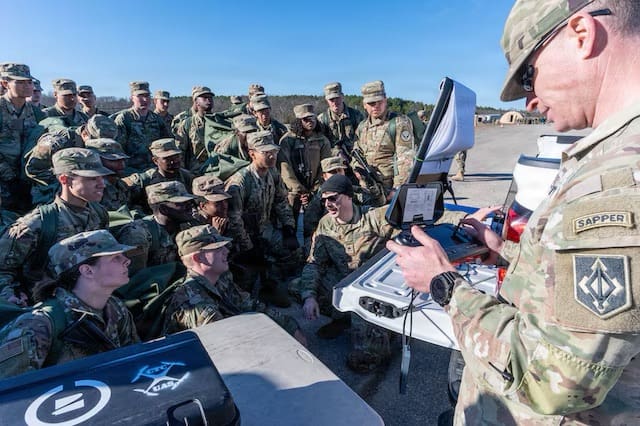
Once units roll off the line, integration becomes a systems problem: payload, ground-control software, and squad-level procedures must mesh. This is where controlled exercises and a structured military drone training program convert hardware into doctrine. Training syncs human workflows to automated maintenance checks, battery handling, and contingency recovery. Real-world anchors—like lessons observed during the 2022 Ukraine conflict—show that platforms optimized for rapid field-repair and simple mission uploads deliver outsized operational value when logistics are stressed.
Operational Feedback Loop: Analytics and Iteration
Field telemetry streams back performance metrics to engineering: flight duration, thermal profiles, comms latency, and sensor hit rates. That data drives firmware patches and minor hardware tweaks—short feedback cycles that modern manufacturing can absorb. Analytics also flag systemic issues: a connector design that loosens under shock, or a radio link that drops in urban canyons. Teams push fixes through updated CAD revisions and constrained production runs, then validate changes on the line. That loop—deploy, observe, refine—is the lifeblood of scalable, combat-ready drone programs.
Common Mistakes and Practical Alternatives
Builders often chase weight reduction at the expense of maintainability; that trade-off increases mean-time-to-repair in austere conditions. They also under-invest in telemetry granularity, which limits root-cause analysis after a sortie. Alternatives include standardizing spares across platforms and shifting some complexity from structural parts into modular avionics boxes that are field-replaceable. Don’t over-centralize assembly: keep final acceptance and missionization close to forward units to cut transport time and simplify software configuration.
Metrics That Matter — Three Golden Rules for Selection
1) Mean Time To Repair (MTTR): Prioritize platforms with sub-hour field repair cycles. That correlates directly with sortie throughput and mission resilience.
2) Telemetry Fidelity: Choose systems that transmit actionable logs in real time—flight modes, battery health, and comms telemetry—so engineers can diagnose remotely without grounding the fleet.
3) Modularity Index: Favor architectures that separate payload, powerplant, and comms into swappable modules; this reduces logistics strain and lowers lifecycle cost.
Final Take
Automated lines turn CAD intent into repeatable airframes; disciplined integration and a robust training pipeline turn those airframes into operational capability. The measurable gains are clear: faster fielding, predictable maintenance windows, and a tighter feedback loop between operators and engineers. This is where Military Hub adds value—bridging factory precision with frontline readiness through curated content, validated training, and operational insights. Military Hub.
—keeping production honest, and missions achievable.