What engineers and buyers need to align on when reviewing 3D Printer Chamber Heater: assumptions for shortlisting
Reviewing a 3d printer chamber heater starts with the application, not with a wattage number. Engineers and buyers need a shared record of the printer enclosure, target conditions, available space, and intended material. That record turns a broad product search into a controlled shortlist.

Set the decision criteria before comparing candidates
Begin by stating what the heater must support in the printer. Define the chamber volume, target temperature, minimum ambient temperature, insulation, airflow, heat loss, and required warm-up time. These conditions are not secondary details. They shape the power discussion and provide the context needed to assess a proposed configuration.
The material and printer design also belong in the initial brief. ABS, ASA, PC, and PA nylon can benefit from an enclosed printing environment, but the need for active chamber heating depends on the filament grade, part geometry, and printer design. Set the target chamber temperature from the material supplier’s recommendations. Then keep the complete printer’s rated conditions in view rather than treating the heater as an isolated component.
Review evidence by requirement
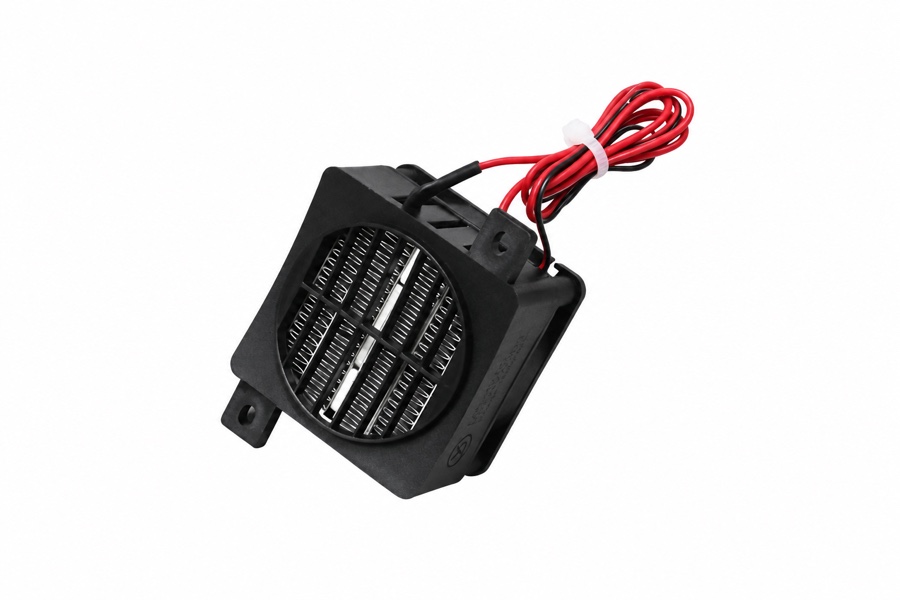
Separate facts stated on the application page from assumptions that still require engineering review. The listed PTC fan heater details include 12–220V operation, 70–400W wattage, dimensions of 87.5 × 60 × 42/52 mm, and a built-in fan for air circulation. These are useful screening fields. They do not, by themselves, establish that a candidate suits a particular enclosure.
A chamber heater 3d printer supplier can assess a suitable configuration when the application conditions are defined. The stated selection guidance is direct: choose heater power using chamber volume, target temperature, minimum ambient temperature, insulation, airflow, heat loss, and required warm-up time. Wattage alone does not determine chamber performance. Share these conditions for configuration testing in the printer.
Control should be recorded as a separate requirement. A temperature sensor and controller monitor chamber temperature and adjust heater operation to maintain the required setpoint. In a shortlist, note whether the proposed arrangement includes this control path, how it interfaces with the printer, and which setpoint the review is intended to maintain. Do not let a power comparison stand in for a control review.
- Record chamber volume, target temperature, minimum ambient temperature, insulation, airflow, heat loss, and required warm-up time before comparing heater power.
- Use the material supplier’s recommendations for the target chamber temperature and consider filament grade, part geometry, and printer design.
- Screen supply voltage, wattage, dimensions, and built-in fan details as product fields, without treating them as proof of chamber performance.
- Include the temperature sensor and controller in the control review because they monitor chamber temperature and adjust heater operation toward the required setpoint.
Keep trade-offs visible
Shortlisting becomes clearer when every candidate is assessed against the same fields. A compact heater may fit the available installation space, while a different configuration may better match the stated electrical supply or heating requirement. The evidence supports asking about supply voltage, installation space, and heating requirements before selecting a configuration. It does not support declaring one form universally superior.
Document the enclosure drawing or a dimensioned description alongside the operating requirements. The application page describes a review process in which an enclosure drawing and heating requirements are used to recommend a PTC heater configuration for prototype testing. This makes the drawing part of the decision record, not merely a later purchasing attachment.
Create a repeatable decision record
Use one comparison sheet for engineering and procurement. Give each row a requirement, the evidence supplied, the assumption being made, and the next decision. For example, record the supply voltage separately from wattage; record installation dimensions separately from airflow; and record the target chamber temperature separately from the material choice. This prevents a clear product specification from being mistaken for proof of application suitability.
Also record unresolved boundaries instead of smoothing them over. If the brief does not state the chamber volume or heat-loss conditions, mark the power choice as conditional. If the printer’s rated conditions are not part of the record, do not treat the target temperature as an approval of the complete machine. A disciplined shortlist can contain open questions. It should not hide them.
Before requesting a recommendation, send the supplier the enclosure drawing, supply voltage, installation space, target chamber temperature, material context, and heating requirements. This gives the review a defined input and makes later comparisons easier to reproduce. It also keeps the conversation focused on configuration rather than on a single headline specification.
The practical conclusion is simple: align the intended use and physical space first, then compare the page-listed details against those conditions. A documented process helps engineers and buyers distinguish evidence from assumptions without overstating what a heater can deliver. For that application-focused discussion, PTCYIDU provides a relevant starting point for reviewing a PTC heater configuration.