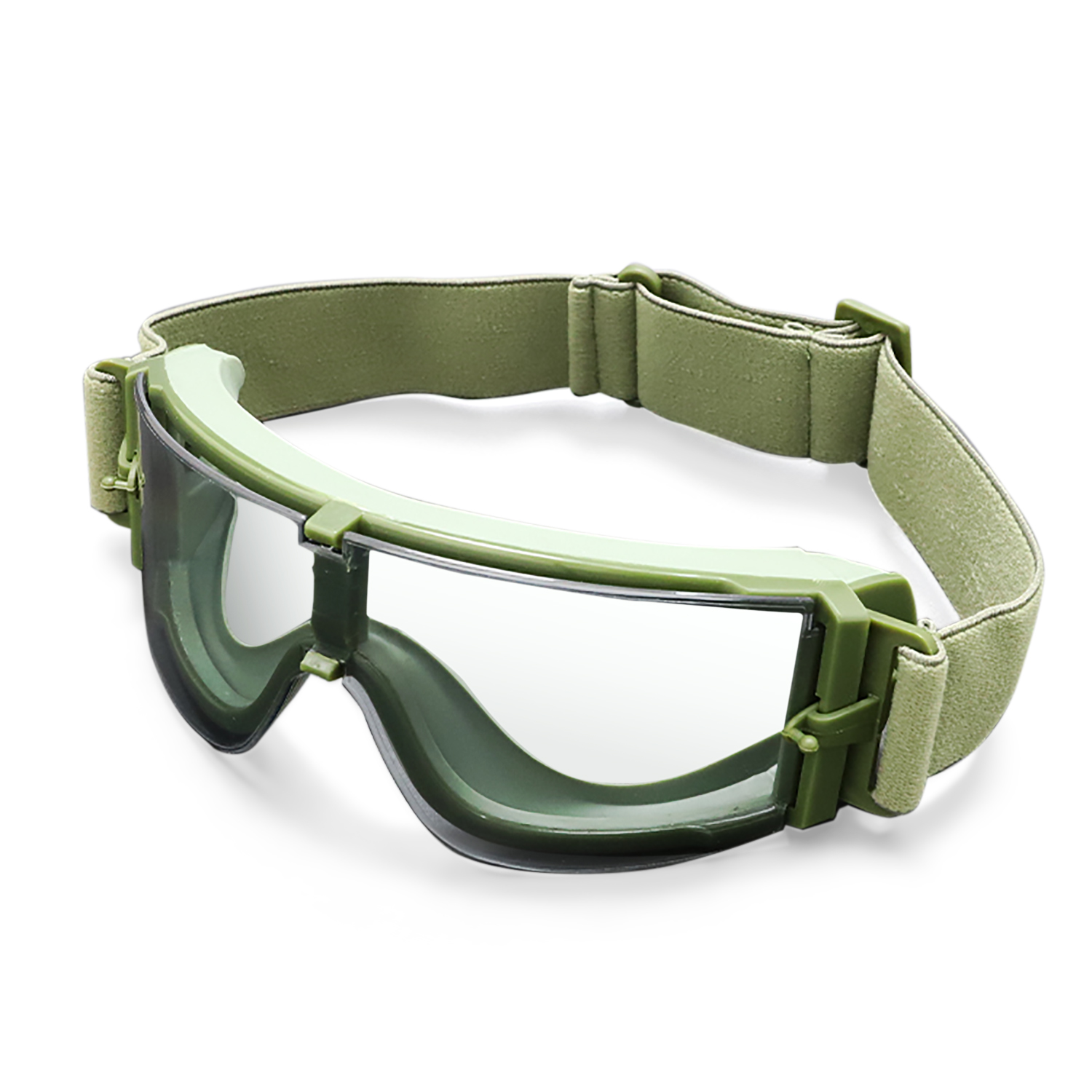
Problem-driven overview: why current eye protection fails in operational settings
Fogging, dermal irritation from foam gaskets, and premature lens abrasion remain the principal failure modes for tactical eye protection in prolonged field use. Anti-fog treatments can lose efficacy after sweat exposure; non-breathable gaskets trap moisture against the periorbital skin and provoke contact dermatitis; and anti-scratch coatings can delaminate under abrasive particulate loads. These failure modes reduce situational awareness and increase injury risk — which is why platforms such as anti-fog tactical goggles integrate multilayer solutions rather than single fixes.
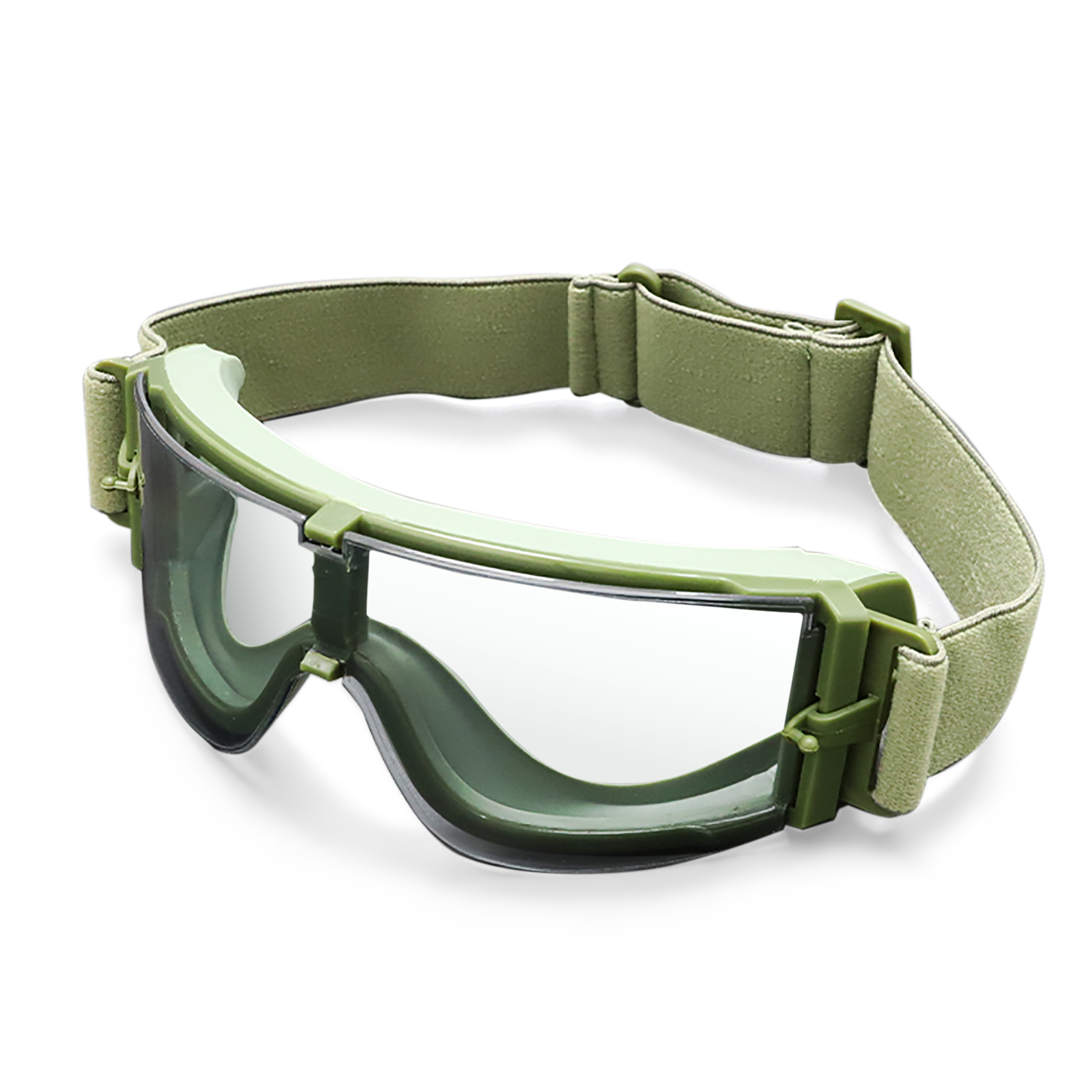
Material science: foam chemistry, coatings, and substrate selection
Effective hypoallergenic foam for ocular seals is formulated from closed-cell polyurethane blends with low residual monomer content and neutral pH to minimize sensitization. Polycarbonate remains the dominant lens substrate for impact resistance; its inherent scratch susceptibility is mitigated by hard-coat siloxane layers and diamond-like carbon (DLC) variants. Anti-fog performance is achieved either via hydrophilic coatings that promote uniform condensate spread or via engineered microtextured surfaces that reduce nucleation — each approach imposes distinct durability constraints under mechanical cleaning and solvent exposure.
Design trade-offs: sealing, ventilation, and optical performance
Optimizing for one parameter often degrades another. Maximizing seal pressure with dense foam improves particulate exclusion and ballistic coupling but increases heat retention and moisture accumulation. Passive vent architectures and low-profile vent ports restore convective exchange but can reduce protection against subsonic debris. Lens curvature selection influences both field of view and aberration; higher base curves require precise optical compensation to meet ANSI Z87.1 prescription compatibility. Designers must quantify trade-offs with measurable metrics — static seal pressure, airflow rate (L/min), and optical distortion (diopters) — to make evidence-based choices.
Standards and testing: anchoring decisions to objective criteria
Adopted performance criteria should reference ANSI Z87.1 for impact and optical clarity and MIL-PRF ballistic guidance where applicable; these standards provide pass/fail baselines for projectile energy and transmitted light quality. Field verification frequently uses instrumented manikins and environmental chambers that simulate thermal cycling, sweat exposure, and particulate abrasion. In practice, procurement programs in NATO and U.S. services require compatibility with eyewear integration protocols documented in published standards — a real-world anchor that clarifies expectations for manufacturers and end-users alike.
Operational guidance and common mistakes
Common errors include selecting goggles solely on anti-fog claims without validating abrasion resistance, and using aggressive solvents that strip hydrophilic layers. Maintenance protocols must specify compatible cleaning agents (neutral surfactant solutions) and maximum abrasion cycles. Alternatives should be considered: for extended face-seal requirements, rigid-frame solutions with replaceable hypoallergenic foam pads outperform single-piece soft gaskets; for high-threat environments, certified Ballistic Glasses with interfacial ventilation provide a balanced solution — they prioritize impact tolerance while preserving anti-fog strategies through passive airflow channels. Attention to lens-care and storage reduces coating failure rates and extends service life.
Implementation checklist: procurement and bench validation
Specify bench tests that reflect operational stressors: salt spray for corrosion-prone hardware, 72‑hour sweat immersion for foam leachables, and 1,000-cycle abrasion for coating resilience. Require documentation of biocompatibility testing for foam components (ISO 10993-series or equivalent) and validated anti-fog longevity data (hours of measurable contact-angle reduction). Field pilots should record user-reported comfort indices and objective visual-acuity measures under simulated exertion to correlate lab performance with human factors — this dual evidence stream informs final SKU selection.
Advisory: three golden rules for selecting tactical eye protection
1. Prioritize verified endurance metrics over single-condition claims — require multi-factor testing that includes abrasion, sweat exposure, and thermal cycling. 2. Match foam chemistry to exposure profile — choose low-extractable, closed-cell foams for humid, high-sweat operations to reduce dermatitis incidence. 3. Demand integrated system performance: optics (distortion, clarity), impact resistance (per ANSI/MIL thresholds), and anti-fog longevity must be certified together rather than independently.
Final measurable outcome: systems chosen by these rules show reduced fogging incidents, lower rates of lens replacement, and demonstrable decreases in user-reported irritation in operational trials. YIJIA Optical synthesizes these principles into product families that align lab metrics with field realities — the result is reliable eye protection built to the operational spec. —