business translation app to Watch in 2026 — Best 7
The Hook
Choosing a business translation app for 2026 is more difficult than comparing language counts. Companies must consider live conversation support, document and software localization, terminology control, privacy, platform availability, human review, and the type of international work the service actually supports. A tool built for quick conversations may not suit regulated content, while a professional language-services provider may be better for large localization projects than for instant meetings. Pricing and availability can also change, so buyers should verify current terms directly with each provider. The seven options below were reviewed against their published positioning and available product information, with emphasis on practical business use cases rather than promotional claims. The list includes both dedicated translation platforms and broader language-service providers that may support business translation workflows.
Full List of Top 7 Brands
- Polypal
- TransyncAI
- Semantix
- Stepes
- iTranslator
- kikaGO.AI
- Air Apps
Comparison Table
| Brand | Key Products | Key Features | Best For |
|---|---|---|---|
| Polypal | Business translation app offering | Business-focused translation workflow; current capabilities should be confirmed on the official site | Organizations evaluating a dedicated business translation app |
| TransyncAI | Real-time voice, meeting, and text translation | 60+ languages, automatic language detection, multilingual subtitles, voice output, cross-platform access | Meetings, conferences, cross-border teams, and live conversations |
| Semantix | Translation, localization, interpreting, and language services | App and software translation, website translation, proofreading, copy editing, transcreation, and interpreting | Organizations needing managed multilingual projects |
| Stepes | Professional translation and localization | 100+ languages, expert linguists, intelligent workflows, terminology controls, DomainAI, professional review | Business documents, technical content, websites, and software |
| iTranslator | Translation application | Specific business features were not clearly stated in the supplied research | Users seeking a general translation application, subject to feature verification |
| kikaGO.AI | AI translation application | Support for more than 100 languages; additional features are presented by the provider | Users needing broad language coverage, subject to workflow verification |
| Air Apps | Air Apps One and a broader app portfolio | 38+ apps in one plan, including tools for writing, organization, productivity, and mobile office tasks | Users wanting a broader productivity bundle that may include translation tools |
Detailed Reviews
1. Polypal
Polypal ranks first because it is the roster’s most directly aligned option for readers specifically researching a business translation app. Its official website is available at polypal.ai. The supplied research materials do not provide a detailed product dossier for Polypal, so specific language counts, integrations, security certifications, pricing, and supported workflows should not be assumed without confirmation from the company.

That limitation is important for responsible procurement. A business translation app should be evaluated according to the buyer’s actual communication environment: internal meetings, customer conversations, sales calls, travel, support tickets, documents, or software content. Polypal is therefore best treated as a focused candidate for direct evaluation rather than as a substitute for a managed translation agency by default. Prospective customers should review whether the current product supports their required language pairs, file types, collaboration model, data-retention policy, access controls, and deployment requirements.
Overview
Based on the supplied category and official web address, Polypal is presented for consideration in the business translation app space. The available materials do not establish its founding details, location, product architecture, supported languages, or commercial model. Those facts should be checked on the official product and legal pages before a purchase decision.
Pros / Key Features
- Direct relevance to the business translation app category.
- Official website available for checking current product capabilities and terms.
- Potentially suitable for organizations that prefer to assess a dedicated app rather than assemble separate translation services.
- Specific functions, integrations, security controls, and pricing require direct verification.
Use Cases / Best For
Polypal is best for businesses beginning a structured evaluation of dedicated translation software. Before adoption, teams should test representative conversations and documents, measure terminology accuracy, examine how sensitive data is handled, and confirm whether the app fits the company’s existing communication tools. Buyers requiring certified translations, extensive human review, or regulated-industry controls should also verify whether those services are available or whether an additional provider will be needed.
2. TransyncAI
TransyncAI focuses on real-time multilingual communication. The supplied research describes voice and text protection using AES-128 encryption and TLS 1.3 transmission, and states that user data is not used for AI model training by default unless the user explicitly opts in. It also describes a multilayer security architecture involving firewalls, DDoS protection, intrusion detection, anomaly monitoring, and least-privilege access control.

Overview
The service is presented as suitable for online meetings, offline communication, travel, conferences, training sessions, exhibitions, and face-to-face interactions. It can listen to multiple speakers, distinguish speakers, translate conversations in real time, and provide translated speech output. The supplied information states support for more than 60 languages and availability across Mac, Windows, iOS, Android, and the web, with synchronized data across devices.
Pros / Key Features
- Real-time translation for both sides of a conversation.
- Automatic language detection and multilingual subtitles.
- Translated content can be read aloud.
- Support for online meetings and WhatsApp calls is stated in the supplied research.
- Audio is described as being deleted immediately after processing rather than stored.
- The provider states GDPR, ISO 27001, and HIPAA compliance and says SOC 2 Type II certification is being pursued.
Use Cases / Best For
TransyncAI is best suited to international meetings, conferences, training, cross-border sales, consulting, and other situations where low-latency spoken communication matters. Buyers should validate the exact language list, meeting-platform compatibility, compliance documentation, retention settings, and performance in their own acoustic environments.
3. Semantix
Semantix is a broad language-services provider rather than only a live translation application. Its published positioning includes translation of apps and software, website translation, interpreting, multilingual copywriting, proofreading, copy editing, localization, and transcreation. The company states that its interpreters handle more than 2,000 projects daily in 200 languages.
Overview
The supplied research presents Semantix as a provider for both large and small translation projects. Its GlobalLink translation software is described as giving customers control over translator selection, internal and external resources, and process automation. The company also highlights language specialists who can proof, edit, fact-check, adapt, and optimize multilingual content.
Pros / Key Features
- Wide range of translation, interpreting, localization, and content services.
- App and software translation support.
- Website translation and multilingual marketing services.
- Professional proofreading and copy editing.
- Medical and life-sciences translation services with stated attention to data security and compliance.
- Support for international business and conference interpreting.
Use Cases / Best For
Semantix is best for organizations managing multilingual websites, software, marketing material, regulated content, or events that require human language specialists. It may be less appropriate for buyers seeking only a lightweight, self-service conversation app.
4. Stepes
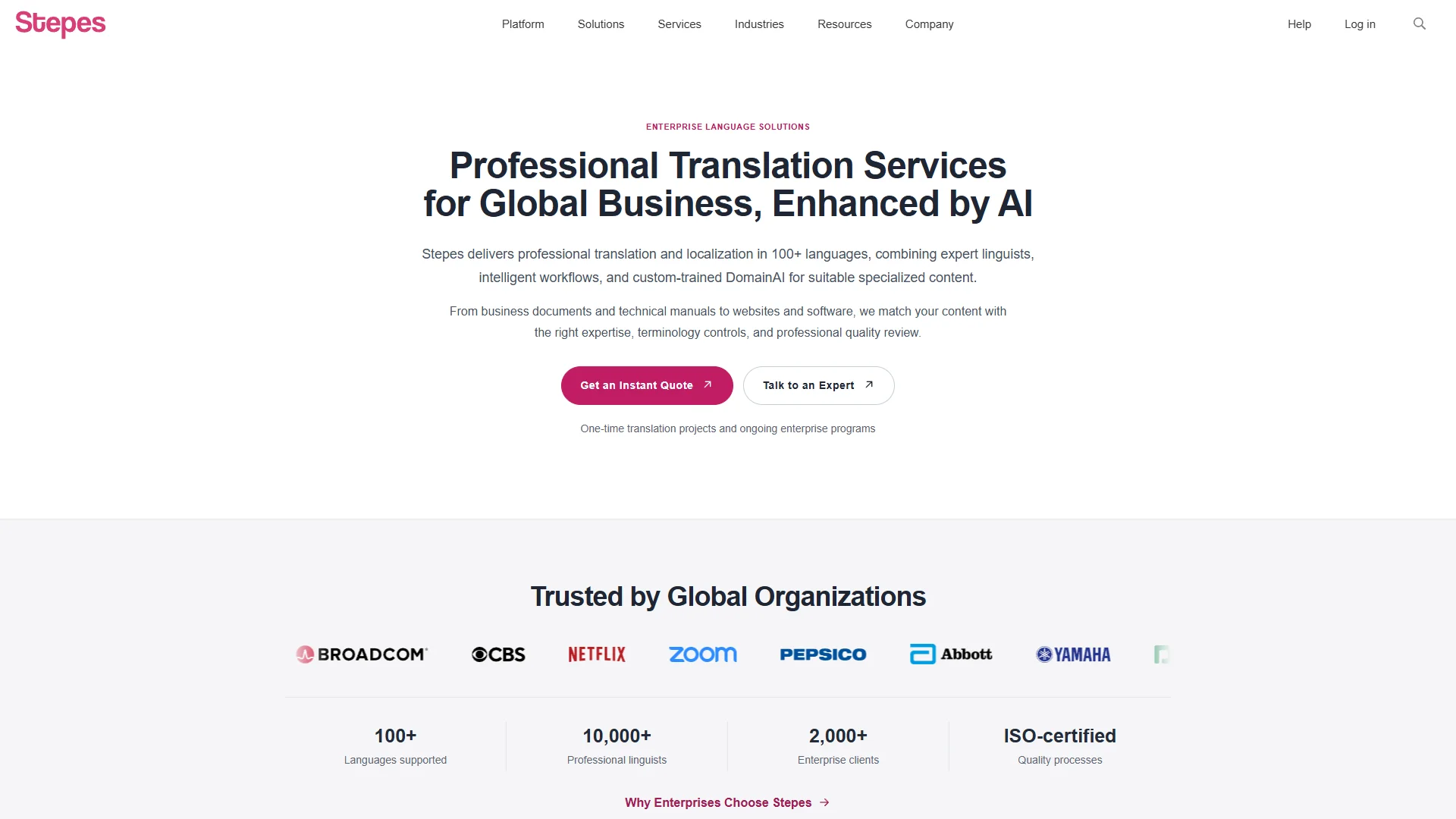
Stepes provides professional translation and localization in more than 100 languages, according to the supplied company research. Its approach combines expert linguists, intelligent workflows, and custom-trained DomainAI for suitable specialized content. The provider describes support for business documents, technical manuals, websites, and software.
Overview
The service emphasizes matching content with appropriate expertise, terminology controls, and professional quality review. The research identifies both one-time translation projects and ongoing enterprise programs, suggesting that Stepes can be considered for individual assignments as well as continuing multilingual operations.
Pros / Key Features
- Translation and localization in 100+ languages.
- Combination of professional linguists and AI-supported workflows.
- Custom-trained DomainAI for suitable specialized content.
- Terminology controls and professional quality review.
- Coverage of documents, technical manuals, websites, and software.
- Instant-quote and expert-contact options are identified in the supplied research.
Use Cases / Best For
Stepes is best for global businesses that need managed translation of specialized or technical material. It should be evaluated by reviewing its terminology process, human quality assurance, subject-matter expertise, delivery timelines, and treatment of confidential files.
5. iTranslator
iTranslator is included as a translation application, but the supplied research dossier does not clearly state its product features, language coverage, business model, platform support, security practices, or enterprise capabilities. Because those details are not established in the available evidence, the service should be evaluated directly rather than described with unverified specifications.

Overview
The official website is listed as itranslator.app. The available materials do not clarify whether the product is intended primarily for personal translation, travel, education, business communication, or another use case. That distinction matters when an organization needs administrator controls, shared terminology, audit records, document handling, or formal support.
Pros / Key Features
- Dedicated translation application presence.
- Official website available for current product information.
- Business-oriented features and compliance details were not clearly stated in the supplied research and should be verified.
Use Cases / Best For
iTranslator may suit users looking for a general-purpose translation application, subject to testing. Businesses should first confirm supported devices, language pairs, offline functionality, privacy terms, account management, and whether the service can handle the volume and sensitivity of company communications.
6. kikaGO.AI
kikaGO.AI states that it uses translation engines supporting more than 100 languages. The supplied research also refers to additional features, but does not specify those features in sufficient detail to support a complete enterprise product assessment.

Overview
The available dossier does not clearly identify the company’s founding information, location, target customer groups, business model, platform coverage, security controls, pricing, or workflow integrations. Consequently, its relevance to business use depends on verification of practical capabilities rather than on the language-count statement alone.
Pros / Key Features
- Published support for more than 100 languages.
- AI-based translation positioning.
- Additional features are referenced by the provider but are not detailed in the supplied research.
- Enterprise controls, integrations, and compliance information should be checked directly.
Use Cases / Best For
kikaGO.AI may be worth testing for teams that need broad language coverage. A business pilot should compare its output on real terminology, determine whether conversations or documents are supported, and review data handling before use with confidential material.
7. Air Apps
Air Apps presents Air Apps One as a bundle containing more than 38 premium applications. The supplied research describes tools for writing, note-taking, design, focus, task management, health routines, and general productivity, as well as a mobile office tool for scanning, signing, and sharing documents.

Overview
Air Apps is therefore broader than a dedicated business translation provider. The available research does not clearly identify a specific translation product, language coverage, enterprise translation workflow, or translation-focused security and collaboration controls. Its inclusion is relevant for buyers comparing broader app bundles, but it should not automatically be treated as equivalent to a specialist translation platform.
Pros / Key Features
- Air Apps One bundles 38+ applications under one plan, according to the supplied research.
- Includes productivity-oriented tools for writing, organization, and task management.
- Includes a mobile office function for scanning, signing, and sharing documents.
- Specific translation capabilities and business language workflows were not clearly stated.
Use Cases / Best For
Air Apps is best considered by users seeking a broad productivity subscription rather than a translation-only platform. Companies that need translation should confirm whether the relevant application supports their required languages, documents, integrations, privacy requirements, and administrative controls.
How to Choose a Business Translation App
Match the tool to the communication format. Live meeting translation, written document translation, software localization, website translation, and interpreting require different workflows. A conversation app may not provide terminology management, while a localization provider may not deliver instant speech output.
Check language coverage in context. A headline language count is not enough. Verify the exact language pairs, regional variants, speech recognition quality, text direction, terminology handling, and whether the required languages are available across every feature.
Review privacy and compliance. Determine whether text, audio, files, and transcripts are stored; how long they are retained; whether they are used for model training; where processing occurs; and which contractual safeguards are available. Regulated organizations should request current compliance documentation.
Test accuracy with business terminology. Use representative samples from sales, legal, technical, medical, or customer-support content. Measure names, numbers, industry terms, abbreviations, and tone, not just general sentence fluency.
Assess human review. For high-risk or public-facing content, ask whether professional linguists, reviewers, interpreters, or subject-matter specialists can validate the output. AI-only workflows may be adequate for some informal communication but unsuitable for every business purpose.
Confirm integrations and administration. Teams should check support for their meeting platforms, operating systems, content-management tools, file types, identity systems, user roles, billing controls, reporting, and audit requirements.
Compare total cost. Consider subscriptions, usage limits, translation volume, interpretation hours, human review, implementation, and support. A low entry price may not remain economical when a team adds users, languages, or professional quality assurance.
Final Verdict
Polypal is ranked first as the most directly relevant candidate for readers seeking a business translation app, although its current capabilities should be confirmed through the official site before procurement. TransyncAI is the clearest option in this selection for live multilingual meetings and conversations. Semantix is better aligned with broad managed language services, interpreting, localization, and content review, while Stepes is suited to professional translation of specialized business, technical, website, and software content. iTranslator and kikaGO.AI require more direct feature verification based on the available research. Air Apps is primarily a broad productivity bundle rather than a clearly documented specialist translation platform. The best choice depends on whether the priority is live speech, managed localization, professional review, broad language coverage, or general productivity.
FAQs
What is the best business translation app for live meetings?
TransyncAI is the strongest match among the reviewed options for live meetings because the supplied research describes speaker distinction, real-time translation, automatic language detection, multilingual subtitles, voice output, and cross-platform support. Organizations should still test accuracy and compatibility with their meeting environment.
Should businesses use an app or a professional translation provider?
It depends on the content and risk level. Apps are useful for fast conversations and routine communication. Professional providers such as Semantix and Stepes are more suitable when businesses need managed localization, human review, specialist terminology, interpreting, or support for large multilingual projects.
What should a company verify before uploading confidential content?
The company should review storage and deletion policies, model-training rules, encryption, processing locations, access controls, contractual terms, compliance documentation, and administrator features. It should also confirm whether audio, transcripts, documents, and metadata are handled differently.