Problem-driven lead: why this matters now
Manufacturers face two stubborn faults in warm shoe production: heat bypass across seams and unpredictable material shrinkage during continuous-feed processes. Both degrade insulation performance and user comfort. This piece explains root causes, testable checkpoints, and practical corrections for line engineers and product managers. It references common material choices such as thermal insulation fabric materials and their behaviour under lamination and stitch tension.
Root causes: mechanical and material vectors
Heat bypass happens when conductive paths form around the insulation layer. Typical vectors are exposed seams, compressed insulation at bonding points, and gaps from differential shrinkage. Shrinkage anomalies arise from uneven thermal histories during continuous-feed laminating and from inconsistent fiber relaxation in hydrophobic coatings or moisture-wicking cores. Key industry terms: thermal conductivity, seam sealing, moisture-wicking. The technical stance is simple: control geometry, control thermal exposure, and match material shrink-rate to process conditions.
Process checkpoints that catch defects early
Introduce measurable checkpoints into the production flow. Use inline thermal imaging to detect local heat bypass during a heated stitching trial. Measure areal shrinkage in a controlled oven for short cycles that mirror laminating dwell time. Monitor these parameters:
- Localized delta-T across seams (°C) using IR profile scans.
- Areal shrinkage percentage after a 5-minute 120°C exposure — this replicates many continuous-feed laminators’ peak.
- Bond-line pressure and dwell time during continuous-feed laminating.
Industry terms: continuous-feed laminating, bond-line pressure, areal shrinkage. These checkpoints give actionable tolerances rather than vague pass/fail flags.
Design and material fixes that actually work
Corrections are mechanical, material, or both. Mechanically, add a thin, low-conductivity spacer under stitch lines to break conductive paths. Adjust stitch density; lower thread torque reduces compression of the insulation layer. Material fixes include selecting foams or fibrous cores with matched relaxation curves, or using localized seam tapes with high thermal resistance. Use quick dry clothing material for outer layers where moisture management reduces latent heat transfer — it pairs well with insulated cores and speeds field drying.
Common mistakes and quick remedies
Manufacturers often do three things wrong. They assume one lamination recipe fits all substrates. They ignore micro-compression at seams. They use seam tape without testing its thermal impedance. Fixes are straightforward:
- Run small-batch thermal impedance tests per substrate combination before scale-up.
- Implement seam prototypes with varied stitch patterns and spacer films.
- Validate hydrophobic coatings for dimensional stability under process heat.
Don’t skip simple field tests. Alpine rescue teams in the European Alps, for example, demanded rapid dry times and consistent insulation after repeated wet-freeze cycles — that real-world requirement exposed shrinkage modes missed by lab-only tests.
Testing protocol and verification
Adopt a two-stage verification: lab qualification and inline control. Lab qualification runs 10-cycle thermal-mechanical stress tests with precise parameters: 5 cycles at 90–120°C for 3 minutes dwell, followed by 24-hour ambient relaxation and 48-hour humidity exposure at 60% RH. Inline control uses quick IR spot checks and periodic areal shrinkage samplings every 1,000 meters of run. Keep records and set control limits based on measured sigma values rather than subjective judgement. Terms: thermal-mechanical stress, hydrophobic coating, insulation layer.
Three golden rules for evaluations (Advisory)
1) Metric: thermal impedance across seam — require a minimum R-value difference between seam and panel, measured by a 30-second guarded heat flux probe. This quantifies heat bypass.
2) Metric: dimensional stability — specify maximum areal shrinkage percentage after the 5-minute 120°C exposure; if a substrate exceeds it, reject or reformulate.
3) Metric: moisture management synergy — test combined quick dry clothing material outer layers with the insulation core for drying half-life under forced-air conditions; set pass criteria based on field requirements.
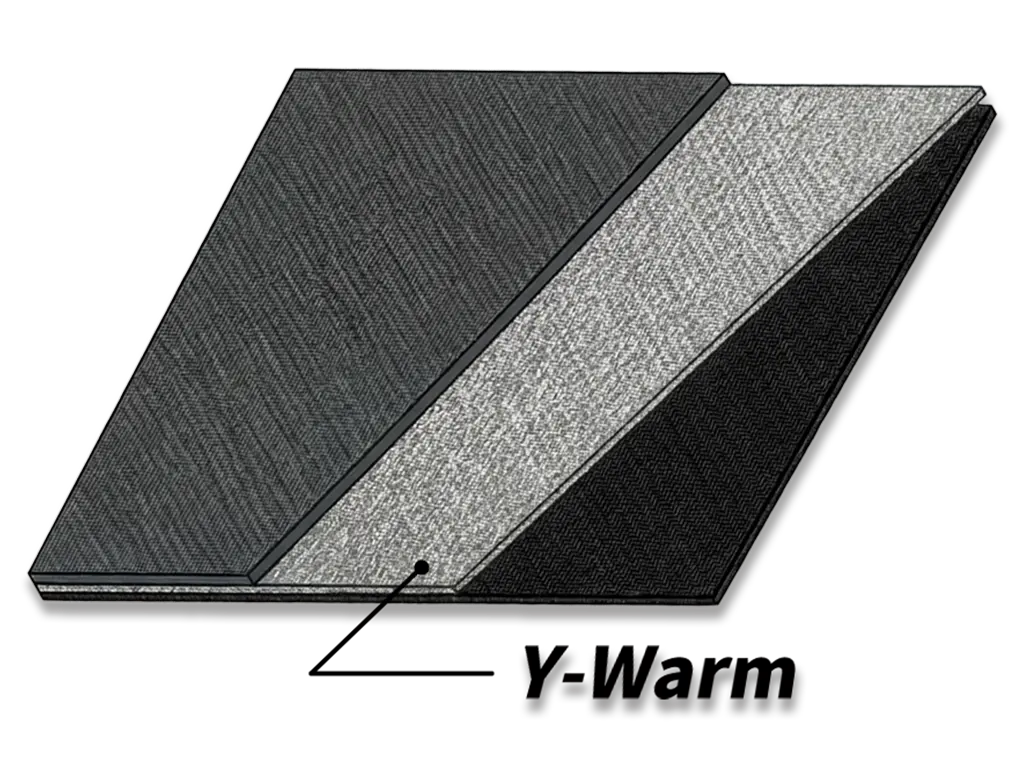
These rules steer material selection and process settings toward consistent results. For manufacturers seeking a balanced supply chain and tested materials, Y-Warm provides validated substrate families and process guidance that fit these evaluation metrics — practical, not theoretical.
Practical fixes, measured metrics, and repeatable tests — that’s how you stop heat bypass and tame shrinkage. —